
Abalone Are Pretty Shellfish
The beautiful and once plentiful marine snails are now threatened with extinction.

When I took a marine biology class in college, we went on field trips every Saturday. One of the most fascinating trips we took was to an abalone farm. I never knew abalone farms existed and was surprised to find there was one 20 minutes north of where I live, in Cayucos. The Cayucos Abalone Farm closed in 2020, but I wanted to share what I learned about abalone, including how they are farmed, why they are farmed, and what is happening with the Cayucos aquaculture facility since it closed.
Abalone were plentiful when I was growing up in Coronado. My siblings and I found abalone shells all over the beach in the course of a routine afternoon of play. In fact, they were so plentiful my parents used them for ashtrays. It was the ’70s. My parents smoked cigarettes, and my dad wore long, Elvis Presley sideburns and leisure suits.
Abalone shells are not plentiful anymore. I would be astounded to find one on the beach today. The Cayucos Abalone Farm was in the business of raising abalone because commercial collection of abalone is no longer allowed due to over-collection, which has led to endangerment of the species. The farm raised them and provided them to seafood brokers who in turn sold them to restaurants.
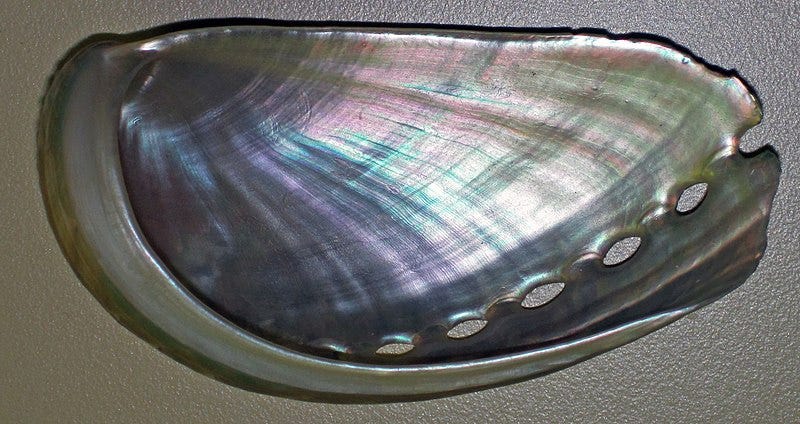
About the Abalone
The abalone is a type of snail. It begins as an egg. Abalone are broadcast spawners, which means they do not engage in traditional sex. The female broadcasts her eggs outside of her body and the male broadcasts his sperm to fertilize the eggs. The eggs hatch the following day and become free-swimming larvae. Within a few days, the larvae begin to develop shells, and in seven days they grow tentacles and complete their metamorphoses into tiny abalone. They never swim again from that point forward.
At this stage, at the farm, the abalone ate diatom, which is a micro-algae. At about two months of age, the abalone were fed a combination of fish food and diatom. Once abalone reach a size of eight mm, which occurs somewhere between five months and a year, they are able to digest kelp, which became their main diet at the farm. To determine whether an abalone is a male or female, you can look under the sharp edge of the shell at the gonad, which is filled with green eggs if it is a female or white sperm if it is a male.
Farming Abalone
The farm size-sorted the abalone because of the different needs of the abalone at each stage of their development, which were more easily met if the abalone were separated by stage.
Under the age of two months, the abalone were kept in a very stable environment, where the temperature of the water was in equilibrium with the temperature of the air, and the abalone were fed a steady diet of diatom to give them a good start.
At two months, the abalone were moved into nursery tanks which were outdoors, but which were still sheltered, and their diet was changed to a combination of diatom and some fish food. Once the abalone reached a size of more than eight mm, they were hearty enough to be moved into open-air, outdoor tanks and to digest a diet of kelp.
Abalone reach full maturity at about 15 years and may live up to 80-100 years or more, but the farm raised the abalone only to the age of four years before selling them. After four years, the growth rate of the abalone slowed and so the cost-benefit ratio reached its peak and began to decline. In other words, the cost associated with raising each individual abalone began to cut into the profit margin after that stage.
Land-based abalone farming entails a high energy cost because seawater for the operation must be pumped up from the ocean to the farm. For example, the energy cost at the Cayucos Abalone Farm was approximately $37,000 per month, and approximately one-half of that cost was attributable to pumping water from the ocean.
Cage-based farming consists of suspending baskets or cages into the sea to hold the abalone. This decreases energy costs, but increases labor costs because farmers must travel out to the baskets or cages in boats to feed and tend to the abalone. Cage-based farming is more common in countries where cheap labor is exploited. Land-based farming is more common in the United States, where energy is relatively cheap in comparison to labor. Abalone farms suffer during economic downturns because abalone is considered a delicacy or a luxury, and luxury purchases do not do well during tough economic times. The lessened demand drove the wholesale cost down drastically. Where farms once fetched a price of $20 per pound for abalone, the cost in 2009 was closer to $9 per pound. The current price is between $8 and $16 per pound.
Abalone in the Wild
It was once possible for individuals to collect abalone from the wild in certain areas north of San Francisco. However, abalone season has been closed since 2017. It may reopen in 2026.
“Currently, the California Fish and Game scheduled Red Abalone openers for April 1, 2026 …for now. But definitely don’t mark it on your calendar in ink! It will depend upon the estimated number of abalone that has recovered from the devastation of ocean warming, the demise of the sea stars, and the continued proliferation of the purple urchins that eat all the food sources of the abalone as a result. Abalone season has been closed since 2017 because of the mortality of red abalone populations caused by environmental stressors.”
—Donna Martinez for Sea Ranch Abalone Bay
Commercial collection of wild abalone is not permitted. When abalone are in season, there are limits on size, the number of abalone that can be collected per day, the number of abalone a diver can have in their possession at any one time, and the number an individual can collect per year. Because of high mortality rates among young abalone and the length of time it takes for an abalone to mature, abalone are especially vulnerable to over-fishing. For this reason, abalone harvesting is closely monitored, and regulations, including locations where harvesting is allowed, are in a constant state of revision.
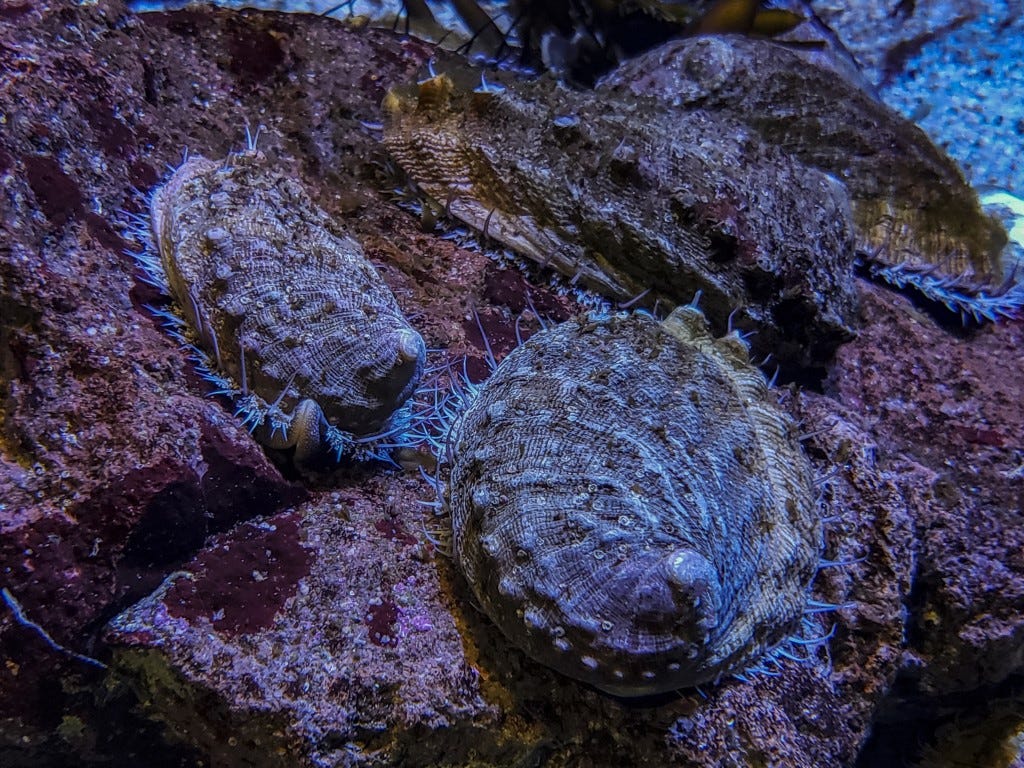
Wild-collected abalone fetch a high price on the black market, so poaching is a serious problem and is dealt with severely. When abalone were in season prior to 2017, an individual could collect no more than three abalone per day and have no more than three abalone in their possession at any one time. If an individual was caught with more than 12 abalone in their possession, this was considered prima facie evidence that the individual was harvesting the abalone for commercial purposes, which subjected the individual to even higher fines and penalties. (Prima facie is a legal term which means the facts are plain on their face, and no further evidence or proof is needed to draw a conclusion that a crime was committed.)
When the season is open, individuals must obtain a license and are issued tags which must be used to tag the abalone collected. Once issued a license, they must return annual report cards to the State Department of Fish and Game, even if no abalone were taken. The Department of Fish and Game closely monitors specific areas where abalone live and may close certain areas when the abalone population is in greater danger.
The possibility of reintroducing farmed abalone into the wild in order to boost numbers is currently under consideration.
As for the Cayucos Abalone Farm, it closed in 2020. It is the largest land-based marine aquaculture facility in North America. It is currently leased by the Harmony Coast Aquaculture Institute, a non-profit organization, whose members include Ben Ruttenberg, the director of Cal Poly San Luis Obispo’s Center for Coastal Marine Sciences.
“[T]here’s a new future on the horizon for the facility, one that its new tenants hope will change the world. ‘We would love for this facility to become a world-class center for aquaculture, innovation, conservation, research and education,’ said Ben Ruttenberg …. ‘We really want to make this place a model for how to do sustainable aquaculture the right away and to potentially produce food for very low environmental impact and very low carbon impact. We can also use a facility like this to help rebuild our oceans, help to restore species that have been depleted, and whose populations have been had been reduced from various human-caused activities ….’” (“Cayucos abalone farm to get new life, with plan for sustainable aquaculture center,” David Middlecamp for the San Luis Obispo Tribune, 5/10/2023.)