
Farmerworkers Day
How the 1970s Farm Labor Movement Impacted a Teenage Girl

Note: This post was originally published on 3/29/2024. I updated it on 3/27/2026 in the wake of multiple sexual assault allegations against Cesar Chavez and the passage of California Assembly Bill 2156 on 3/26/2026, which officially changed the name of the March 31st holiday to Farmworkers Day.
I think this change is appropriate not only because of the allegations against Chavez but because this was a movement by a people, and Chavez was only one person out of many involved in creating change. The new name acknowledges this.
It strikes me, too, that this essay is largely about the duality of man and how a person can be two opposing things, which is particularly appropriate today. I don’t want to erase the good Chavez did, but I don’t want to celebrate and glorify him either. I prefer to celebrate all of the farmworkers who grow and harvest our food.
March 31st is Farmworkers Day here in California. Farmworkers Day is a state holiday, celebrated in the states of California, Texas, Arizona and Colorado. This year, it falls on a Sunday, so we’re celebrating on Monday. It is the only U.S. holiday honoring a Mexican-American.1
On his special day, I find myself reminiscing about how the Farm Labor Movement touched the life of a 16-year old girl back in the 1970s. I was born in an era of great change in the area of civil rights. I still shake my head in amazement when I realize that Brown vs. Board of Education was decided just over 60 years ago, and women were given the right to vote under the 19th Amendment to the U.S. Constitution only 40 years prior to that. It's really not that long ago. Think about it: There are lots of people alive today who were alive during a time when women were not permitted to vote and Black people were bused to schools outside their own neighborhoods because they were not permitted to attend the same schools as white people.
In the 1960s, 1970s and 1980s, the Farm Labor Movement, under the leadership of Cesar Chavez, Dolores Huerta, and many others, made its own significant contributions to the civil rights movement by organizing Mexican-American farm laborers, helping them to achieve fair wages, fair hours and better working conditions, and lending its support to the movement to outlaw the use of toxic pesticides in fields where farm laborers worked and breathed.
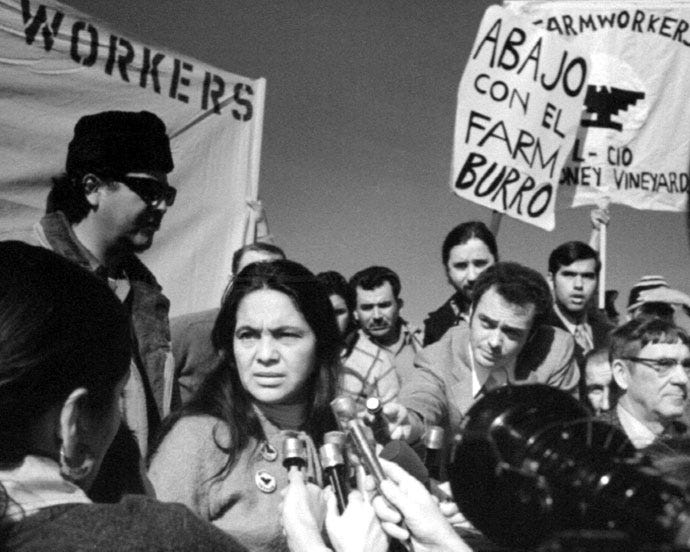
During the 1970s, I lived in the Salinas Valley, a hotbed of activity in the farm labor movement. My grandfather, Arvil Lee "Doc" Calvert, was a ranch foreman for Merit Packing Company. He had us kids riding on tractors and digging carrots and potatoes from a very young age. I adored him. He was a wonderful man, a hard worker, and one of the most kind, good-natured and jovial people I've ever had the pleasure to know in my life.
It’s strange thinking back on that period of my life now, in the context of the times. As a ranch foreman, my grandpa came at it from a different perspective. He didn’t see the need for a union and saw only the potential problems unionized labor would cause for the farming industry. I’m sure he believed the ranch owner, who said he couldn’t afford to pay more or to offer better working conditions. Although I’m not sure even he recognized it, I think he was afraid of the movement and felt his own livelihood was threatened.
While the 1970s Farm Labor Movement was a peaceful movement, there were some who were not so peaceful in their protests—mostly strikers who were angry with scabs who crossed the picket line. And there were times when my grandpa feared for my grandma’s safety when she was working alongside him in the fields, whether that fear was rational or not. He and I had our first (and only) argument when he found out that I had signed a petition in support of farm labor unions.
Looking back, I realize now that my grandfather’s views of what was going on were colored by his own experiences. Knowing him, I can’t believe he fully realized the atrocities that were taking place at other ranches and farms, because he was not like that and could never be like that. I fear I’m being an apologist or have a “not all ranchers” mentality. In some ways, I know I am, because I loved my grandfather, I think he was an amazing and loving person, and he is not here to defend himself or to explain how he felt back then. I can only surmise.
Not to psychoanalyze, but when a man is not a cruel or manipulative or dehumanizing person, I think it is very difficult for him to wrap his brain around the fact that there are people who would or could commit such atrocities. I’ve learned that, as a writer, when men who would never do some of the things the men in my stories do, they think my stories are far-fetched and offensive. When cruelty and prejudice do not live in one’s own heart, it is difficult to understand or accept that it continues to this day to thrive in the hearts of others.
In my grandfather’s day-to-day life, he was beloved by his employees and related to every human being in the same way, without regard to race or ethnicity. I saw this in action, and he was one of my best role models in that regard.
I remember waking up at my grandfather’s house very early many mornings, only to find him coming through the front door, stamping mud off his work boots, and stopping at the wash basin in the mudroom entry to wash up, fingertips to elbows, with Lava soap. By the time I woke up, he had already been out working, from 2 a.m. or 4 a.m., changing the irrigation pipes so, for example, the guy whose job it normally was to do that task could stay home with his wife and new baby. He’d then come into the living room, and after paying me two bits to unlace his work boots, he’d take me up on his lap and sing me songs like Old Dan Tucker; You Get a Line, I'll Get a Pole; or How Much is That Doggie in the Window?
Again, I feel like I’m being somewhat of an apologist for my grandfather saying these things, and on the other hand I feel like I’m betraying him by pointing out his shortcomings, especially when he’s not around. It’s complicated. My grandpa was a good human being. He had close friends from many different cultures and backgrounds. Everyone loved him. But he was also a product of the times and of his situation and position, so I believe he was misinformed and misguided when it came to the farm labor issue. It’s the same today—people continue to think that there isn’t enough of anything to go around.
As I reflected on these things this morning, I wondered how many good, decent, hard-working people, in the past and in the present, have been uninformed and misguided about the state of the world and the human condition. I like to think of myself as enlightened, but really, thinking about it just drives home to me how much more there is in the world that I don't know about. I wondered what kinds of things might be going on in the world today that I could never imagine or believe exist. The times they are a-changin’, but there is still so much left to change.
But this isn’t what I set out to write about. I set out to write about the Farm Labor Movement. And I think and hope I’ve done more justice to that movement in another essay I’ll publish someday. For now, I hope you’ll take some time to learn about the Farm Labor Movement, which was filled with incredible human beings who devoted their lives to lifting others up.
At the time I first wrote and published this piece on 3/29/2024, the holiday was called Cesar Chavez Day. It fell on a Sunday that year and was celebrated the following day, a Monday.