
How I Almost Got Published
Newsletter Issue #87

This is embarrassing. So embarrassing I don’t necessarily want to write about it. But I’m sharing it with you because it was a good lesson, and I hope you can learn something from it and I can save you the embarrassment.
I recently submitted an essay to a well-known and highly respected online magazine that publishes craft essays on writing memoir and creative nonfiction. I’ve been reading the publication for years and include links to its essays often, under “Some Things for Writers,” so I’m familiar with the kinds of essays they publish. It’s important to familiarize yourself with a publication before submitting to it—check!
I have a short essay I thought would be perfect for this market. The topic of the essay is writing accountability partners. I read the guidelines carefully, as I always do—check!
The essay was a little long for this particular publication, so I edited it down to their 850-word sweet spot, polished it up, and submitted it. Check, check, check!
I didn’t have to wait long for a response—according to Duotrope, this publication’s response time is faster than most, and they were right. I got my response within 11 days.
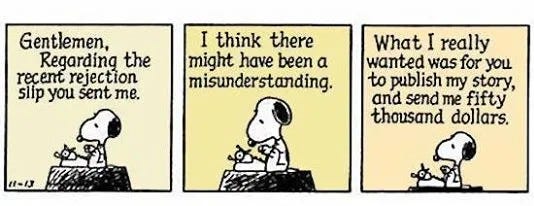
Unfortunately, the response was a no. I get a lot of no’s. Every writer who is out there submitting work gets more no’s than yesses, and publishers reject work for so many reasons that have nothing to do with a piece’s worth, so I don’t tend to take rejections hard or personally. But this particular rejection was embarrassing because I’d violated a cardinal rule of submitting work.
As I mentioned, the publication is devoted to the craft of writing creative nonfiction and memoir. Although my topic of writing accountability partners crosses all genres, each and every reference I’d made in the essay was to fiction: novelists, novels, fictional characters, storytelling, even the elements of the craft of writing fiction. Although my topic was applicable to writers of all kinds, my essay decidedly leaned into fiction and wasn’t suitable for the market I’d submitted it to.
So, I got a “no,” but it’s pretty clear I had been on my way to a “yes” except for that big blunder. I know this because the kind editor who declined the essay had already begun editing it when she realized my mistake, and she was generous enough to send her suggested edits to me, along with some encouragement to submit elsewhere.
I honestly couldn’t believe my brain hadn’t made that connection, but the truth is, although I thought I was being careful, I hadn’t been careful enough. I hadn’t taken my time to carefully consider whether the piece was right for the market I was submitting it to. I’d done a cursory consideration of that, and I’d wasted an editor’s time. As an editor myself, I felt especially awful about that part.
Here’s another lesson to be learned from this experience. Be resilient and be persistent. A no isn’t a forever no. It’s a “not this time.” So bounce back from it quickly and move forward. The piece that wasn’t right for this publication will be right for another. I’ve found the next market I’ll submit my essay to (a craft publication focused on fiction), and I’ve carefully checked to make sure my essay is suitable for this market, including reading the publication’s guidelines carefully and reading other pieces from the publication to see if mine is indeed be a good fit. I’m back in revisions, grateful to be armed with the notes I received from a generous editor at a publication I continue to admire. Wish me luck! :)
XOXO
Leanne
P.S. I’m thinking a lot about character arc these days and will probably write about it soon. In the meantime, this issue is filled with quotes and resources about character arc and development.
“The character drives the plot, and the plot molds the character’s arc.
They cannot work independently.”
—K.M. Weiland
NEWS & ANNOUNCEMENTS
I’m participating in a roundtable discussion about 19th century author Alice Cary at The American Literature Association’s annual conference, May 20-23, 2026, at the Palmer House in downtown Chicago, Illinois. More details to follow.
I’ll be presenting at the Central Coast Writers’ Conference September 25-26, 2026, at Cuesta College in San Luis Obispo, California. More details coming soon.
Looking Ahead: I’ll be speaking to SLO NightWriters at their general meeting on Tuesday, October 13, 2026, at 6:30 p.m. Details to follow.
“Every character should want something, even if it’s only a glass of water.”
—Kurt Vonnegut
BONUS LESSON ON CREATING CHARACTERS FROM GILLIAN FLYNN:
“For Gone Girl, I knew Nick and Amy had to be very believable, so I made iPod playlists for them, and knew their Netflix queues. I wrote scenes of them in childhood from other people’s points of view: A scene of Amy in high school, written from her friend’s POV, or Nick’s kindergarten teacher writing about parent-teacher conference night. Stuff I knew I’d never use, but would help me flesh them out. I do that a lot when I’ve hit a writer’s block—it keeps me writing and sometimes helps solve a problem. Amy’s Cool Girl speech started as a writing exercise, but that one I liked so much I kept it for the book. Once I have a first draft, then the actual real work for me begins, because then I can see the novel as a whole and see what needs work. I do tons of rewriting; it’s where the book becomes a book.” —Gillian Flynn
“Growth stings. Let your character pay for what they learn.”
—Sarah Branson
SOME THINGS FOR READERS
White Oleander: Janet Fitch’s novel is the California Book Club’s March 2026 selection
(Dustin Snipes for Alta Journal)
Why You Should Read This: White Oleander
(David L. Ulin for Alta Journal)
Confessions of a Terminal “Divorce Kid”
(Essay by Sari Botton for Adventures in Journalism)
What Remains to Be Said
(Essay by Ellie Eberlee for Los Angeles Review of Books)
Franny’s Papers: What was lost when Claire Douglas’s archive burned
(Essay by Satya Doyle Byock for Los Angeles Review of Books)
Helga Seeks the Unicorn
(Fiction by Melissa Darcey Hall for The Rumpus)
“I like characters who have strong facades and then have secrets. They have cracks.”
—Eva Green
SOME THINGS FOR WRITERS
Why I Write: To Make Meaning Out of Chaos
Janet Fitch’s White Oleander is the California Book Club’s March 2026 selection.
(Janet Fitch for Alta Journal)
How a Strong Character Arc Can Make Readers Love Your Protagonist
(Jerry B. Jenkins for Writer’s Digest)
Writing 101: Character Arc in a Nutshell
(Angela Ackerman for Writers Helping Writers)
Note: This one has some great downloadable tip sheets for creating character arc.
Character Development: Lessons from Amy Tan
(Beth Kephart for The Brevity Blog)
7 Common Character Arc Problems and How to Fix Them
(Sarah Branson for Writer’s Digest)
What Top 3 Literary Agents Want to See in a Live Conference Pitch
(Heather Garbo for Writer Your Next Chapter)
How Reading for a Lit Mag Improved My Writing
(Kate Levin for Lit Mag News)
Behind the Magic: Why Writing About Writing Works
(Andrea A. Firth for The Brevity Blog)
“Put something in the path of your character, something odd that they can’t easily explain.”
—Laura Venita Green
SOME THINGS TO MAKE YOU SMILE
“That’s what books are for …. To travel without moving an inch.”
—Jhumpa Lahiri, The Namesake
Leanne Phillips
Writer | Book Coach | Editor
leannephillips.com
Thanks for reading my newsletter! If you liked it, please share it with a friend who might enjoy it. If you didn’t enjoy the newsletter, you can unsubscribe below.
You are such an incredible editor and teacher that editor could not resist you. She was probably trying to work and angle to publish it too, before anyone else. Hahahahaha! I love this!
I just submitted three poems - one has a typo. A sneaky typo. I didn't capitalize a word... I feel your frustration. Best wishes for your piece. And since I submitted three, I'll just hope for the best or send it elsewhere.